


The Hidden Risks of Share-Based Compensation
Part I – Know The Odds
“Stock markets go up over time.” True.
“Stocks go up over time.” Mostly false.
Over the last 100 years, while the S&P 500 annualised around 10%, this wasn’t driven by all the underlying stocks. Nor was it driven by most stocks, nor half, nor even a quarter of them.
Only 3.72% of the 29,081 stocks accounted for the entire net wealth creation of large publicly listed US companies from 1926 to 2025.
If you were invested in the other 96.26%, you would have gotten the same returns as risk-free, one-month bonds.
Nearly 6 in 10 stocks didn’t even beat an asset with no risk.*
If you work for a company that has some form of share-based compensation (SBC), are you confident your company’s stock is going to be one of the 3.72%?
It might be worth considering your options and downside risks.
Imagine you and your friend were working for tech companies back in 2003. You were a hardware engineer at Research in Motion, the maker of the BlackBerry, and they were a programmer at Apple.
You would probably have been pretty happy-bordering-on-smug earning and holding your allocated $RIM stock. It shot up 400% in the past year alone and the BlackBerry was the professional’s phone. Barack Obama refused to give it up on entering the White House!
Meanwhile, your friend was working for a company that nearly went bankrupt a few years back, currently accounts for only 2% of the PC market, and its stock is back to its post-dot-com lows. Michael Dell said it should be shut down and the money returned to shareholders!
The smart bet seemed to be for you to hold your $RIM and for your friend to sell their $AAPL as soon as they got them.
Of course, you know the ending now, but it’s only obvious in hindsight. “In the business world, unfortunately, the rear-view mirror is always clearer than the windshield”, said a famous investor.**
If you’re working for SpaceX today, is it crystal clear that those shares will beat the market over the next 20 years?
Looking at 30 major tech IPOs, we see significant variability in returns over their first year in the public markets: from +153% for Palantir to -74% for Robinhood. In addition, the average max drawdown over these 12 months was -55%.***
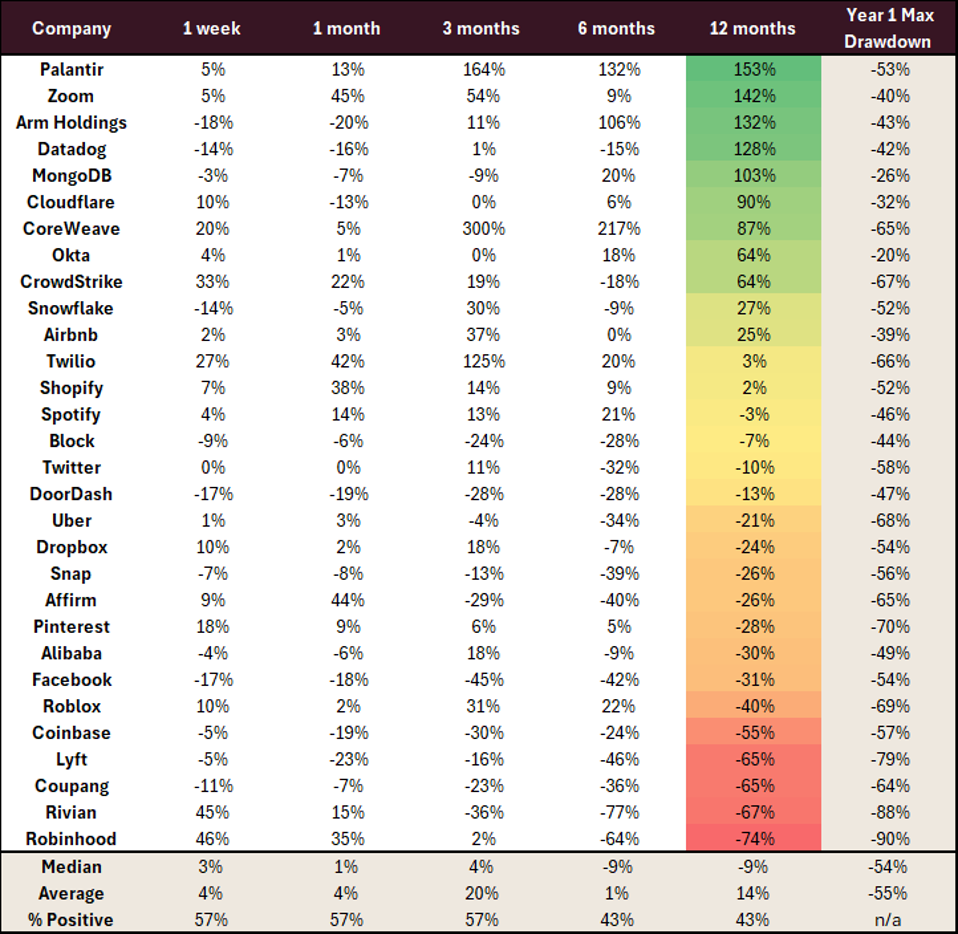
If you want to grow your wealth over time, investing in stocks is the best way. But how you do so is key. You can either aim to knock the lights out with a single stock (massive upside potential combined with catastrophic downside risk) or participate in the continued growth of businesses in general (limited-but-sufficient upside potential combined with non-catastrophic risk).
The kicker with SBC is that the value of your shares is only half the danger.
Your biggest asset might not be your house or your pension or your current shareholdings. It could well be your human capital – how much you could earn until you step back (or are stepped back).
What you really don’t want is your savings, your income, and your career all tied to one company.
Your company might end up more Apple than RIM, but your employer is one draw from the distribution. With 96% of companies combined returning the same as a risk-free asset over their lifetime, holding onto your SBC might not necessarily be offering you the odds you think you’re implicitly betting on.
If you earn SBC, you’ve put in a lot of energy, time, and money to put yourself in that position. It might be worth working with a professional who’ll put in the same shift for you to ensure you’re making the most of it.
* https://papers.ssrn.com/sol3/papers.cfm?abstract_id=6438198
**https://www.berkshirehathaway.com/letters/1991.html
*** Data from MarketWatch and Truist